


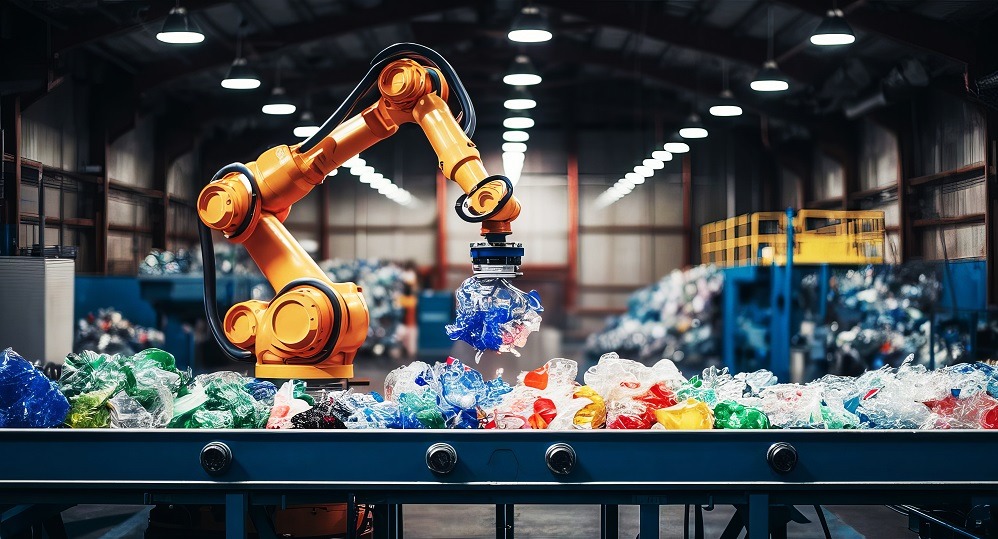
As global waste volumes continue to grow, artificial intelligence (AI) is emerging as a promising solution that could significantly improve recycling efficiency while enabling smarter and more sustainable waste management systems.
Artificial intelligence is transforming industries worldwide, and waste management is no exception. As urbanization accelerates and consumption rises, managing the massive volume of waste generated by modern societies has become an increasingly complex challenge. In this context, AI is beginning to reshape how waste is collected, sorted, processed, and recycled.
The Global Waste Crisis and the Need for Technological Innovation
According to the World Bank’s What a Waste 2.0 report, the world currently generates more than 2.24 billion tons of municipal solid waste each year. This figure is expected to rise dramatically, reaching 3.4 billion tons by 2050 if current trends in urbanization, consumption, and economic development continue.
However, global waste management systems remain inefficient. Around 37 percent of waste ends up in landfills, many of which lack proper environmental safeguards. Landfills not only consume vast areas of land but also release methane, a greenhouse gas that is significantly more potent than carbon dioxide.
At the same time, recycling rates remain relatively low. According to the OECD Global Plastics Outlook, only about 19 percent of municipal solid waste is recycled globally. The situation is even more alarming for plastic waste, as only around 9 percent of all plastic ever produced has been successfully recycled.
These figures highlight the structural limitations of traditional recycling systems. Manual sorting processes, inconsistent waste separation by households, and contamination of recyclable materials all reduce the efficiency of recycling operations. As a result, technological innovation is increasingly seen as essential to improving recycling outcomes.
Artificial intelligence is now being explored as a powerful tool capable of transforming waste management systems by increasing sorting accuracy, optimizing operations, and enabling data-driven decision making.
AI and Robotics Are Transforming Waste Sorting
One of the most critical stages in the recycling process is the sorting of waste materials. If recyclable materials are mixed with contaminants, the quality of recycled products declines and entire batches may become unsuitable for recycling.
Traditional recycling facilities rely heavily on manual labor, where workers stand alongside conveyor belts and separate materials by hand. This process is slow, labor-intensive, and often exposes workers to hazardous materials.
In recent years, technology companies have developed AI-powered robotic systems capable of performing this task far more efficiently. These robots use high-resolution cameras, optical sensors, near-infrared scanners, and machine-learning algorithms to identify materials in real time.
Companies such as AMP Robotics have demonstrated that AI-driven robots can identify and pick thousands of objects per hour. In comparison, a human worker typically sorts around 50 to 80 items per hour, while robotic systems can process 800 to 1,000 items per hour with a high level of accuracy.
Another advantage is that robotic systems can operate continuously without fatigue. While human workers require breaks and shifts, AI-powered robots can run 24 hours a day, seven days a week, significantly increasing the productivity of recycling facilities.
Several recycling plants in the United States and Europe have reported efficiency gains exceeding 50 percent after deploying AI-powered sorting systems.
International Projects Applying AI in Waste Recycling
Around the world, research institutions and technology startups are experimenting with new ways to integrate AI into waste management systems.
In the United Kingdom, the startup Greyparrot has developed an AI-based waste analytics platform that uses cameras and machine learning to analyze materials on recycling facility conveyor belts. The system can identify more than 100 different types of waste materials, including various plastics, metals, paper products, and packaging.
The data collected by the system helps recycling operators understand the composition of incoming waste streams and identify opportunities to improve recovery rates.
Another company, Glacier, based in San Francisco, is developing compact AI-powered robots designed to be installed in existing recycling plants without requiring major infrastructure upgrades. The company’s long-term vision is to prevent valuable materials from ending up in landfills or oceans.
Academic institutions are also involved in this field. Researchers from the Columbia Climate School have developed an AI-powered floating robot designed to collect waste from the Hudson River in New York. The device can detect floating debris using computer vision, collect it mechanically, and analyze the waste composition to identify pollution sources.
In Europe, several cities are implementing AI-powered smart waste management systems. Smart bins equipped with sensors can monitor fill levels and transmit data to waste management operators. AI algorithms then optimize collection routes for garbage trucks, reducing fuel consumption, traffic congestion, and carbon emissions.
These developments illustrate how AI is gradually transforming waste management from a reactive service into a data-driven infrastructure system.
AI Enables Identification of Complex Materials and Electronic Waste
Another key advantage of AI lies in its ability to identify complex or difficult-to-sort materials.
Plastic waste is a prime example. Many plastic products appear visually similar but consist of different polymer compositions that require separate recycling processes. AI systems combined with infrared spectroscopy can identify the unique chemical signatures of plastics and ensure accurate classification.
Electronic waste is another rapidly growing challenge. According to the Global E-waste Monitor published by the United Nations, the world generated 53.6 million tons of electronic waste in 2019, and this figure is projected to reach 74 million tons by 2030. Yet less than 20 percent of electronic waste is properly recycled.
AI technologies can help address this issue by identifying valuable metals such as gold, copper, and palladium inside discarded electronics. Some robotic systems are even capable of disassembling devices to extract reusable components more efficiently.
AI can also detect hazardous materials such as lithium batteries, medical waste, and toxic chemicals, which pose safety risks if processed incorrectly. By identifying these materials early in the recycling process, AI systems help prevent accidents and contamination.
Strategic Benefits of AI in the Recycling Industry
Beyond sorting materials, AI provides broader strategic benefits for waste management systems.
Modern AI platforms can collect and analyze operational data from recycling facilities, including temperature levels, material composition, equipment performance, and processing efficiency. This information allows operators to optimize recycling processes and anticipate equipment failures before they occur.
According to studies by the International Solid Waste Association, recycling facilities that integrate AI technologies can increase recycling efficiency by up to 60 percent while significantly reducing contamination in recycled materials.
AI can also improve worker safety. Recycling facilities often expose workers to sharp objects, chemical residues, and hazardous waste. By automating dangerous tasks, AI-powered systems reduce the risk of workplace injuries.
Some waste management companies in North America and Europe report that AI integration has helped reduce labor costs by up to 50–60 percent while improving the reliability of recycling operations.
Challenges and Limitations of AI in Recycling
Despite its many advantages, the adoption of AI in the recycling sector faces several obstacles.
One of the primary barriers is high initial investment costs. Installing robotic systems, sensors, and AI infrastructure can require millions of dollars per facility. For smaller recycling companies or municipalities in developing countries, these costs can be prohibitive.
Another challenge involves data quality and system maintenance. AI algorithms rely on large volumes of training data to accurately identify materials. Maintaining updated datasets and ensuring proper system calibration require ongoing technical expertise.
Energy consumption is also a concern. According to the International Energy Agency, global data centers already consume approximately 1 to 1.5 percent of total global electricity, and this demand is expected to grow as AI adoption expands.
Furthermore, the widespread use of advanced electronics and robotics may contribute to additional electronic waste when outdated systems are replaced or upgraded.
These issues highlight the importance of designing AI systems that are both energy efficient and environmentally sustainable.
Technology Alone Cannot Solve the Waste Problem
While AI can significantly improve recycling efficiency, experts emphasize that technology alone cannot solve the global waste crisis.
Organizations such as the United Nations Environment Programme (UNEP) argue that the most effective long-term solution lies in reducing waste generation at the source. Policies aimed at limiting single-use plastics, promoting eco-friendly product design, and implementing extended producer responsibility are becoming increasingly common worldwide.
When combined with these policies, AI can serve as a powerful tool for building a circular economy, in which materials are reused and recycled repeatedly rather than discarded.
The Future of Recycling in the Age of Artificial Intelligence
Market research indicates that AI-driven waste management technologies are experiencing rapid growth. According to industry analysts, the global market for AI applications in waste management could expand at an annual growth rate of more than 20 percent through 2030.
New recycling plants in Europe, Japan, and North America are increasingly designed with integrated robotics and AI systems from the outset. In the future, smart cities may rely on networks of sensors, automated sorting facilities, and predictive analytics to manage waste streams in real time.
The convergence of artificial intelligence, robotics, and data analytics is opening a new chapter in global waste management. However, the ultimate success of this technological transformation will depend on broader efforts to reduce waste production, improve recycling infrastructure, and promote sustainable consumption.
In a world facing mounting environmental pressures, AI has the potential to become a crucial tool in the transition toward a more sustainable and circular global economy.